
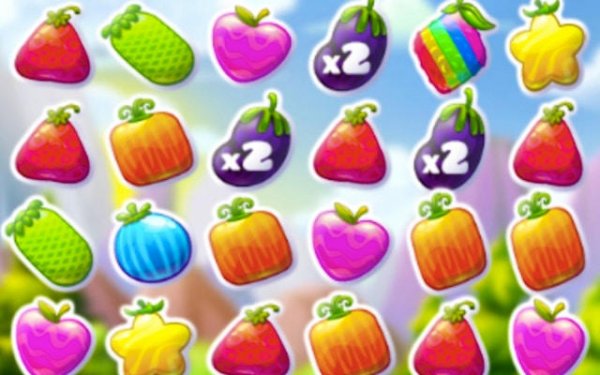
Matching Mechanics
In Fruit Grid Challenge, players interact with a grid filled with fruit tiles. The goal is to swap adjacent tiles to form lines of three or more matching fruits. When a line is completed, those tiles vanish, and the player earns points. New tiles fall from above, which can create additional matches without any extra input. This core loop is straightforward but rewards players who think ahead. Setting up larger combos requires careful observation and planning.
Visual Design and Clarity
Each fruit tile uses bright, distinct colors and simple shapes. This design makes it easy to identify different fruits at a glance, even during fast-paced play. The background is kept minimal, so the grid remains the focal point. Subtle animations accompany tile matches and disappearances, offering satisfying feedback without being overwhelming. This visual approach helps players stay focused during longer sessions.
Level Structure and Objectives
As players progress, levels introduce new goals. Some stages require clearing a certain number of a specific fruit type. Others set a target score that must be reached within a limited number of moves. These varied objectives encourage strategic thinking rather than random matching. The difficulty curve is gentle, giving newcomers time to learn the basics before encountering more complex challenges.
Special Items and Assistance
When the board becomes difficult to clear, special tools can help. A color changer allows players to convert one fruit type into another, potentially creating new matches. Other boosters can clear an entire row or column. These items are earned through regular play or offered as optional purchases. The game remains fully playable without spending money, and using these tools wisely can turn a stalled board into a cascade of matches.
Score Tracking and Competition
Fruit Grid Challenge includes a leaderboard that displays the highest scores achieved by players. This feature adds a light competitive element, motivating players to improve their performance. Scores are calculated based on the number of matches made, the length of chains, and how efficiently objectives are completed. Regular play helps players recognize patterns and increase their scores over time.






Comments
0 comments